
From Friday, December 6 to Monday, December 9, 2024, the fourth edition of Peru Bienal took place at the Museo Aeronáutico del Perú in Lima. The event featured the work of 560 artists selected from 22,566 submissions from 60 countries, encompassing visual, performing, and digital arts.
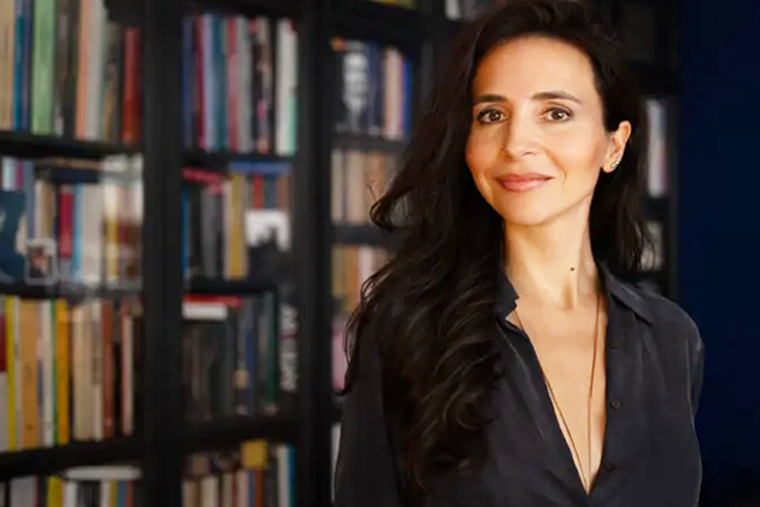
The event’s organization seeks to position Peru as a center for the artistic and creative industries in the region. Among the highlights of the program was the participation of renowned Turkish artist, producer, and filmmaker Mediha Didem Türemen, who presented a conference entitled “Journeys of Inspiration: Inspirations for the Art and Film Industry.”
In an interview with La República, Türemen spoke about her participation in Peru Bienal, her artistic career, cinema, censorship, photography, and the role of art and culture in a polarized world.
Her participation in Peru Bienal
Türemen explained that her relationship with Peru Bienal began two years earlier, although she was unable to attend the previous edition due to unforeseen circumstances. She described her participation in the event as an opportunity to join an intercontinental gathering of art and cultures.
She highlighted the Bienal’s broad selection of artistic disciplines and its international participation. She was particularly pleased that her own works had become finalists in the Bienal’s competitive section.
She also expressed her enthusiasm about sharing her experience at the intersection of cinema and art through her conference, as well as interacting with the Peruvian public.
For Türemen, this was her first visit to Peru, and she expressed her curiosity about the country’s culture, its perspectives on art, and the role of art in Peruvian life.
From theater to cinema
Türemen explained that her interest in stories and visual narratives began during childhood. While studying at Istanbul University, her experience with the university’s theater group deepened her passion for storytelling.
Her theater background later influenced her approach to cinema, particularly through stage design, dramatic structure, and aesthetic elements. She described cinema as a medium that allowed her to create a visual and emotional language while addressing social issues.
After beginning her master’s degree in Cinema-TV at Mimar Sinan Fine Arts University, she further explored the possibilities of visual storytelling.
She has worked both in front of and behind the camera, particularly in independent and auteur cinema. One of the first films she designed competed at the Venice Film Festival.
Since 2020, she has also been involved in the production of Nuri Bilge Ceylan’s About Dry Grasses, an international co-production between Turkey, France, Germany, and Sweden. The film premiered in the main competition at the 2023 Cannes Film Festival and was Turkey’s submission for the Academy Awards.
Art, censorship, and creative freedom
When asked whether artistic expression and cinema are threatened by censorship in an increasingly polarized world, Türemen acknowledged that the risk of censorship is always present.
However, she emphasized the ability of art to resist restrictions and address social issues through creative means.
“As artists, it is our responsibility to tell stories that go beyond censorship.”
She argued that as long as creativity exists, an idea can continue to be expressed in different ways. Cinema continues to find new methods of storytelling even under difficult circumstances, while censorship can also force artists to seek alternative paths of expression.
The central themes of her work
Türemen identifies time, memory, and nature as central themes in her artistic practice.
Her work explores connections between the past, present, and future, incorporating elements such as nature, archaeological symbols, light, atmospheric changes, myths, legends, memories, and dreams.
She approaches the relationship between humans and nature from an animist perspective, combining personal experiences with ecological and cultural concerns.
Through visual storytelling, cultural research, and environmental awareness, her work seeks to create connections across different periods of time and explore the spirit of nature and culture transmitted from one generation to the next.
Latin American cinema
Regarding Latin American cinema, Türemen highlighted Peruvian filmmaker Claudia Llosa and her film The Milk of Sorrow (La teta asustada), which won the Golden Bear at the Berlin International Film Festival in 2009.
She also mentioned filmmakers Alejandro González Iñárritu, Carlos Reygadas, and Amat Escalante, as well as Memoria (2021), directed by Thai filmmaker Apichatpong Weerasethakul and set in Colombia.
Photography in the digital age
Türemen also reflected on the continuing relevance of photography in an era increasingly dominated by video.
She believes photography gives viewers time to contemplate, interpret, dream, and develop their own relationship with an image. Moving images, on the other hand, create a different kind of experience, particularly when sound becomes part of the narrative.
Despite technological changes, she continues to work with a professional camera and lenses, often carrying her equipment when traveling to unfamiliar places. She believes photography still has a unique emotional power and continues to occupy an important place in contemporary culture.
Can art and culture overcome polarization?
Türemen believes they can.
For her, art and culture have the ability to overcome prejudice by highlighting shared human experiences and values. They can encourage empathy and help people understand different perspectives.
She considers cinema particularly powerful because it can tell stories from multiple points of view.
Ultimately, she describes the liberating and unifying power of art as a unique tool for breaking down polarization
 English
  Español